

The most common errors in waste documentation and their consequences

Proper waste recording is the cornerstone of responsible business management in the face of stringent environmental legislation. Every entity generating or managing waste must face the requirements of the BDO system. Many businesses treat these obligations superficially, exposing them to serious sanctions. Expert analysis of control processes indicates that the majority of penalties are due to repetitive failures in records. By understanding the mechanisms by which these errors arise, they can be effectively eliminated.
Do you need help with correct waste recording? Or would you like to make an appointment for training on preparing waste record sheets or waste transfer sheets?
Apply to us:
j.blazewicz@ekologistyka24.pl , +48 500 867 153
Why is reliable waste recording crucial?
Correct record-keeping avoids suspicion of illegal storage or unauthorised shipment of hazardous substances. Inspection authorities, such as the Environmental Protection Inspectorate, verify the integrity of data at every stage of the supply chain. If your waste records are complete, you build an image as a transparent and reliable business partner.
Untimely entries or the lack thereof raise doubts among inspectors already at the stage of preliminary examination of documents. Therefore, constant monitoring of stock levels and receipt dates is essential for the legal security of the company. Professionalism in this area protects not only finances, but also the operational continuity of the plant.
The most common errors in waste record sheets (KEO)
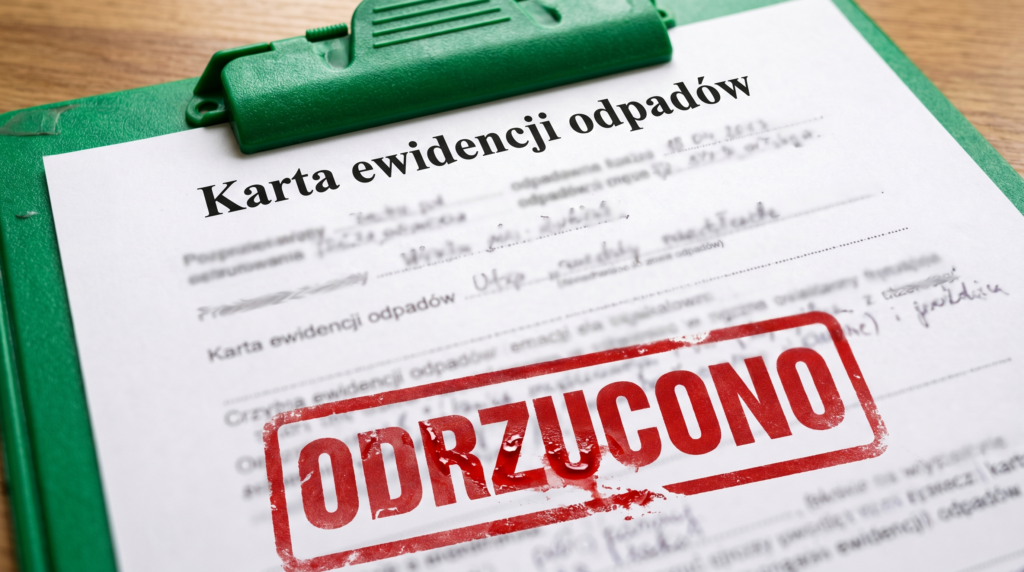
The most common misconduct is the use of incorrect waste codes due to the lack of precise classification of materials. Entrepreneurs often choose generic codes instead of activity-specific ones. This distorts the picture of the company's real environmental impact and hinders recycling processes.
Another critical error is mistakes in waste weight and units of measurement. Waste records must be based on actual measurements weight rather than on estimated values. Discrepancies between the mass produced and the mass transferred are the first signal to controllers, suggesting irregularities in resource management.
Traps in waste transfer notes (KPOs)
Incorrectly completed waste transfer notes often contain incorrect data regarding the transporter or the destination. Many companies forget to confirm the receipt of a shipment in the system in a timely manner. These delays generate gaps in the waste circulation history, which prevents full traceability of the consignment.
In addition, errors often relate to the absence of registration numbers of vehicles transporting waste. Each card must accurately indicate the means of transport and the time of commencement of the operation. Failure to comply with these formalities results in the document being invalid during a roadside check or inspection at the company's premises.
Data inconsistency as a control hotspot

During visits, environmental inspectors focus primarily on cross-checking paper and electronic documentation. They compare the entries in the record sheets with the data appearing on sales invoices and weighing documents. Any differences in dates or volumes become grounds for investigation.
Systematic waste recording therefore requires full correlation between the logistics department and accounting. If the data in the warehouse do not agree with the declarations in the BDO system, The risk of being accused of withholding information arises. Consistency of information is the most important element of a defence strategy during any professional audit.
| DOCUMENT | THE MOST COMMON ERRORS | SKUCE |
| Record Card (KEO) | Wrong code or weight of waste | Administrative penalty |
| Transfer Note (KPO) | No acknowledgement of receipt, incorrect company details, indication of incorrect management method in relation to the type of waste | Presumption of illegal disposal |
| Annual report | Discrepancy with the balance sheet | Correction order and fine |
Legal consequences of documentation failures
Violations of the regulations on documenting waste management carry severe fines. Under the Waste Act, fines can range from a few thousand to as much as one million zlotys. The amount of the sanction depends on the scale of the violation and the potential threat to human health and the state of the environment.
In addition to financial penalties, the authorities may issue a decision to stop the plant's operations. In extreme cases, integrated or sectoral permits for waste generation are revoked. Such legal consequences often mean that a company has to shut down its business operations altogether.
Financial consequences of erroneous record-keeping
Direct administrative fines are only the tip of the iceberg of costs generated by faulty waste records. The company loses money on legal services for appeal processes and additional corrective audits. The need to delegate staff to rectify outstanding entries generates high operating costs.
It is also worth mentioning the loss of benefits resulting from incorrect billing of environmental charges. Incorrect data can lead to overpayments or, worse, underpayments resulting in penalty interest. In the long term, the profitability of the company suffers as it pays for the consequences of its own documentary negligence instead of investing in growth.
How to keep waste records correctly?

The key to success is to implement procedures for regular data entry into the BDO system. Documentation should be created in real time (the legislator makes it clear that this should take place immediately after the occurrence of an event, such as the generation or receipt of waste). Responsibility for these tasks should be given to trained staff who understand the specifics of the waste codes and the processes to which the materials may be subjected.
It is also worth using professional support from external consultants or dedicated software that integrates the scales with the registration system. Automating processes minimises the risk of human error, which is the most common cause of inaccuracies. Regular internal audits, on the other hand, allow errors to be detected before the controlling body does.
The role of staff training in the record-keeping process
Educating the staff directly handling waste processes significantly improves the quality of the documentation produced. Employees need to know how to distinguish between hazardous and non-hazardous waste in workshop or production practice. Lack of this knowledge leads to misassignment of codes, which destabilises the entire reporting system.
The investment in training pays off in the form of peace of mind during inspections and the absence of financial penalties. An informed employee can independently verify the correctness of the data entered by the carrier on the handover slip. This mutual control within the organisation is the best barrier against formal errors.
Digitisation of documentation and the BDO system

The move to fully digitise records within the BDO system was supposed to tighten up the circulation of information, but it has also created new technical challenges. Traders need to navigate the platform interface efficiently to avoid technical errors when generating cards. Knowledge of the system's functionality is as important today as knowledge of the law.
Good digital waste records allow statements and analyses to be generated quickly, making it easier to manage costs. IT systems also make it possible to quickly correct minor mistakes before documents are approved. The use of modern tools is a necessary step for any modern company concerned about compliance.
Importance of internal audits
Regular internal audits are the most effective method of verifying the correctness of the records kept. They allow gaps in the document circulation system to be identified and errors to be rectified before the inspectors arrive. A professional approach to documentation protects the company's assets and builds its reputation in the market. It is important to remember that waste recording is an ongoing process that requires constant attention and updated knowledge. Negligence in this area always generates risks that are not worth taking in a modern business. Attention to detail in environmental documents is an investment in a secure and stable future for any business.
Author: Jakub Koszyński | Editorial: Pawel Makowski