
BDO - who does NOT have to register?

Not every business dealing with waste has to register with the BDO system - and this is where costly mistakes most often occur. In practice, many companies register „just in case”, while others - despite a real obligation - remain outside the system, thereby exposing themselves to severe penalties. In this article, we explain precisely who is actually exempt from the obligation to register in BDO, on what basis, and where the boundary between exemption and obligation to register lies.
Not sure if your company is subject to BDO registration?
Or do you need help with registration?
Contact us and entrust the care of your business to professionals:
e.nadolna@ekologistyka24.pl , +48 881 045 376
j.blazewicz@ekologistyka24.pl , +48 500 867 153
Basic principles of the BDO system
The BDO system is used to collect information on entities marketing packaged products and managing waste. The register enables state authorities to effectively control the circulation of raw materials and monitor recycling levels in the country. Entrepreneurs registered in the database must keep records and submit annual reports. This process requires reliability and knowledge of current legislation.
The rules for registration are primarily governed by the Waste Act and related implementing regulations. These documents indicate that any entity generating non-municipal waste is subject to legal rigour. Nevertheless, the legislator has introduced quantitative thresholds that make life easier for the smallest operators.
Who does not have to register with BDO? General rules for exemptions

Exemptions from registration with BDO mainly apply to individuals and non-business entities. If an entity uses the waste for its own purposes, it does not normally have to apply for registration. This is the case if the residues generated are not related to the business activity. In this case, the law treats such activity similarly to the operation of an ordinary household.
It is also worth noting that the exemption covers transporters of self-generated waste. The condition, however, is that transport is not the main activity of the company. If your business only generates waste of a municipal nature, you also remain outside the system. This is the most common reason why small entrepreneurs do not have to worry about environmental formalities.
Exemptions based on type and volume of waste generated
The Minister for Climate has defined, in a special regulation, a list of types of waste for which the the small amount produced exempts you from the obligation to register in the BDO. This document contains specific waste codes and the weight limits assigned to them, expressed in megagrams (tonnes). For example, an entrepreneur who generates packaging waste will be exempt from keeping records of it - and thus from registering it with BDO - as long as it does not exceed the quantitative limits outlined below:
| WASTE CODE | TYPE OF WASTE | ANNUAL LIMIT (tonnes) |
| 15 01 01 | Paper and cardboard packaging | 0,5 |
| 15 01 02 | Plastic packaging | 0,5 |
| 15 01 03 | Wood packaging | 1,0 |
| 15 01 07 | Glass packaging | 0,5 |
| 15 01 09 | Textile packaging | 0,2 |
This is a very important convenience for craftsmen and small workshops. In addition, the exemption covers certain types of batteries and used electrical equipment in very small quantities. So every company should verify its annual purchasing and stock statements. Such a check legally avoids complex reporting.
Office and professional activities - when is BDO not required?

Office work is usually associated only with the production of paper documentation. In such a business model, waste is most often classified as municipal. This means that the municipality collects it on the same basis as from residents. As a consequence, intellectual service providers rarely appear in the BDO register. This is the case for programmers, lawyers, and translators working remotely.
However, vigilance should be exercised when replacing computer equipment or collecting large quantities of used toner cartridges. If the company itself returns such items to a collection point, this may give rise to a record-keeping obligation. However, most offices use external service providers. The servicer then becomes the generator of the waste and takes responsibility for reporting it. This is a convenient solution that takes the formal burden off the office owner.
Municipal waste versus business waste
The key to understanding the exemptions is to distinguish between municipal and industrial waste. Municipal waste is that which is generated by daily human activities. If a company's employees generate waste similar to domestic waste, the BDO system does not cover it. This includes food leftovers, meal packaging or used paper towels in toilets. The company does not have to keep a waste transfer note for such waste.
The situation is completely different when the business profile dictates the generation of technological waste. Even a small amount of engine oil in the workshop or hairdressing paints changes the legal status. Then the company generates professional waste, which is subject to stricter standards. This is why the precise separation of the social and production spheres is so important. Most disputes with the environmental inspection are precisely due to the misclassification of these streams.
Service and maintenance providers
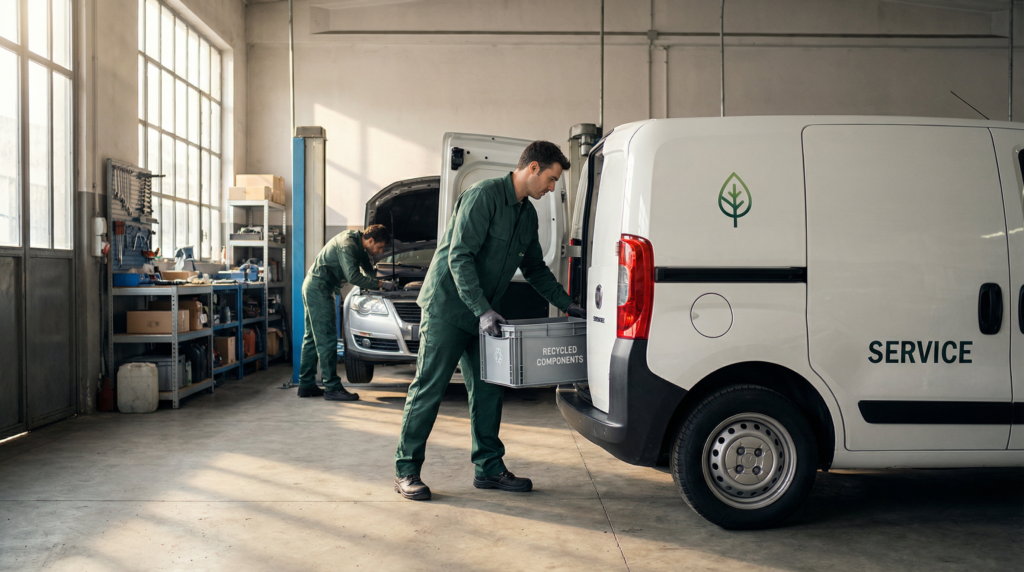
There is a very important exception for maintenance services performed at the customer's premises. According to the Waste Act, it is the service provider who is the generator of the waste generated during the work. If a plumber is replacing pipes at your premises, he is responsible for their disposal and entry in the BDO. You, as the principal, do not need to have a registration number for this. This rule simplifies the documentation workflow in the building and repair services sector.
A prerequisite, however, is that appropriate provisions are included in the service contract. It is worth making sure that the contractor takes responsibility for any residual materials created. In this way, the contractor using external services does not have to worry about record-keeping. In addition, such an arrangement ensures that the waste goes to professional treatment facilities. This is a safe path for most small and medium-sized companies.
Exceptions for farmers and small farms

Farmers with farms of less than 75 hectares often benefit from exemptions. This is especially the case for those who are not subject to the obligation to keep waste records under specific laws. If a farmer only generates waste that can go into the municipal system, he does not need an entry in the BDO. This is an important convenience for traditional family farms. However, the situation changes with intensive industrial production.
In doing so, modern agriculture generates waste such as silage film, fertiliser or plant protection product packaging. In this case, registration is required by law, unless the farmer returns this waste through producer collection schemes. Thus, an analysis of the farmer's status requires an examination of the scale of the operation and the methods of packaging management. However, most small farms can still operate without logging on to the database.
How to check if your company falls under the BDO exemption?
To be sure of your legal position, it is worth carrying out a verification in several steps:
If you import goods from abroad or sell products under your own brand, quantity exemptions do not usually apply. Then any quantity of packaging obliges you to have a BDO number. So the verification process needs to be multi-faceted and take into account all aspects of your business. If in doubt, it is worth consulting an environmental consultant or lawyer.
Consequences of non-registration and legal security
Operating without the required BDO registration involves a high degree of risk. Administrative penalties for non-registration or erroneously kept records can range from several thousand to as much as one million zlotys. Therefore, certainty about the exemption available is crucial for the financial stability of the company. The Environmental Protection Inspectorate regularly inspects businesses for waste management.
At the same time, it is important to remember that environmental regulations change frequently. What was subject to an exemption a year ago may today require notification in the digital system. So regularly following the announcements of the Ministry of Climate and Environment is good business practice. Correctly classifying activities in the context of BDO is not only about not incurring penalties, it is also a testament to a company's environmental responsibility. A professional approach to waste builds a positive brand image in the eyes of customers and clients.
Author: Jakub Koszyński | Editorial: Pawel Makowski