
Notification of waste shipments step by step: what is worth knowing about it and how to avoid mistakes?

Notification is the procedure that legalises some cross-border waste shipments. If a company chooses the wrong mode or starts a transport without the required approvals, it risks cargo detention and administrative consequences. In practice, Notification requires good preparation of documents and consistent operational data. Therefore, below you get a step-by-step instruction, with an emphasis on the places where mistakes most often arise.
DON'T BE TAKEN ABACK BY NEW WASTE TRANSPORT REQUIREMENTS
We will prepare your company for a smooth implementation of DIWASS. We'll check the validity of your permissions, verify the accuracy of your data and help you define the role in which your company will operate in the system. We will also take care of comprehensive DIWASS support and, if you need it, show you how to navigate the system in practice. Get in touch with us:
e.nadolna@ekologistyka24.pl , +48 881 045 376
j.blazewicz@ekologistyka24.pl , +48 500 867 153
Notification of waste shipments - what it is and how it works in road transport
Notification is the general term for the procedure of prior written notification and consent for transboundary shipments of waste. It involves the notifier submitting a formal notification document together with a movement document in which he/she specifies, inter alia, the type of waste, the intended route, the transport participants and how the waste will be managed after delivery. The documentation then goes to the competent administrative authorities in the country of dispatch, the country of destination and the countries of transit. Each of these authorities examines the notification and issues a decision on the planned shipment. Only after the required consents have been obtained can the shipment be carried out in accordance with the approved conditions.
In Poland, the granting of permission for such a transfer is decided by the Chief Inspector of Environmental Protection. What is more, a single application can cover multiple transports, but only within a certain period, up to a maximum of one year. Therefore, it is advisable to plan the volume and schedule already at the application preparation stage.
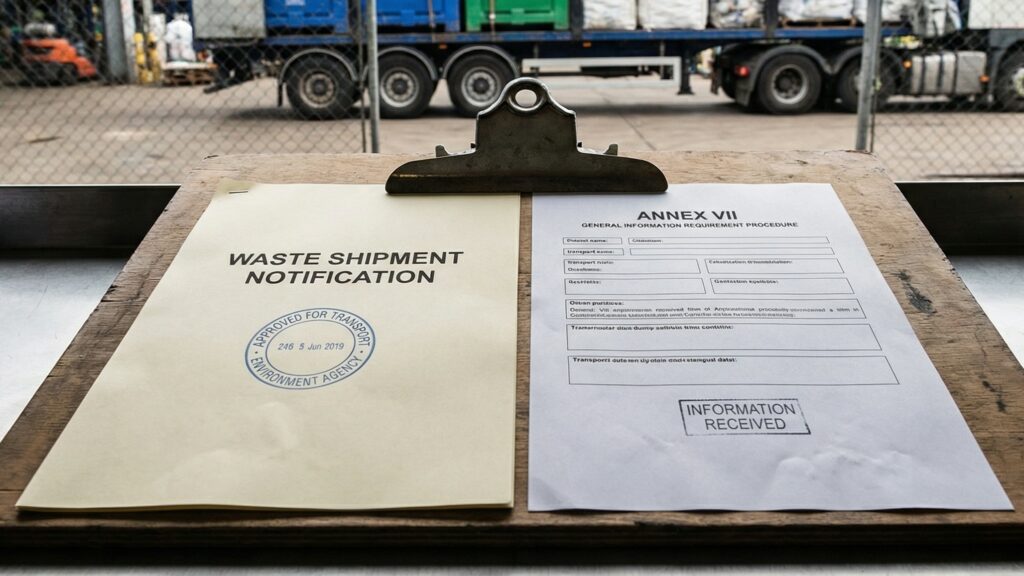
When notification is mandatory and when notification is sufficient Annex VII
Notification is required for, among other things, amber-listed waste destined for recovery, for unclassified waste and many mixtures, and for all waste headed for disposal. In these cases, the authorities must give their consent before the shipment starts.
On the other hand, with part of the displacement in the information mode the form in Annex VII shall be used. In addition, no KPO is issued at BDO for cross-border waste shipments, as the KPO regulations only operate within Poland.
Notification step by step - procedure
In order to go through the procedure smoothly, it is advisable to divide it into several stages and prepare the documents in the right order. It is at the stage of completing the data and annexes that mistakes are most likely to occur, prolonging everything unnecessarily.
In practice, the notification should proceed as follows:
1.Waste classification and mode of shipment
At the outset, the waste code, its status (e.g. green list or waste requiring notification) and the purpose of the transport - recovery or disposal - must be determined.
2. identification of parties and contractual documents
It is necessary to identify all participants in the process: the notifier, the waste consignee, the treatment facility and the hauliers. A contract between the notifier and the receiving facility is usually also prepared.
3 Waste characteristics
The documentation should describe the waste in detail - its origin, composition and properties. In some cases, laboratory test results confirming the classification are also required.
4 Financial security
Prior to the procedure, a financial guarantee or equivalent security shall be prepared to cover the possible costs of return transport or waste management.
5. submission of the notification to the competent authority
The complete package of documents together with the notification form is forwarded to the competent authority of the country of dispatch, which initiates the administrative procedure.
6. Obtaining approvals from the competent authorities
Transport may only commence once the consents of all authorities competent for the country of dispatch, transit and reception have been obtained.
How long is a waste shipment notification valid?
How long does it take to get a decision on a waste transport consent?
The processing time for the notification is set out in Regulation (EC) No 1013/2006 and depends on whether the dossier is considered complete by the competent authority of dispatch.
First, the notification is checked for formality. If the documentation is complete, the authority of the country of dispatch forwards it to the competent authorities in the countries of transit and in the country of destination. Once the complete notification has been acknowledged, the actual administrative procedure begins.
In principle, the authorities have up to 30 days to object or give their consent. In practice, however, the procedure often takes longer because the authorities can:
Therefore, the reality is that it can take from a few weeks to even a few months to obtain approval for waste shipments under the notification procedure, depending on the complexity of the case and the number of transit countries.
How long is a waste shipment notification valid?
Once the competent authorities have given their consent, the notification is valid for a certain period of time during which the transports indicated in the notification can be carried out. In accordance with the provisions of the aforementioned Regulation, the consent is usually given for a maximum of one year. During this period, a certain number of shipments can be carried out or a certain amount of waste indicated in the notification can be moved.
After this period, a new notification must be submitted if further shipments are planned. It is also worth remembering that the consent may expire earlier if:
How much does notification cost - official fees and indirect costs
In Poland, the basic official cost is the stamp duty for issuing a permit to trade waste with foreign countries. It amounts to PLN 14 000 for a permit covering single and multiple shipments, while an amendment to the decision costs 50% of this rate, or PLN 7 000. Added to this is the cost of a financial guarantee or equivalent security. In the case of out-of-country exports, the regulations describe the calculation of the guarantee sum with the formula G = (D + T + M) × A, where:
The regulations also indicate storage rates depending on the type and form of waste. As a result, the budget also increases by analyses, translations, contract preparation and sometimes additional costs on the part of foreign partners.
A critical error that most often ends in a problem
The most serious mistake is to choose the wrong procedure. The company assumes that the information mode is sufficient, even though the waste in question is subject to Notification. Or it starts transporting before it has obtained the consents of all the competent authorities. This cannot be rectified en route.
The second variant of the critical error relates to data divergence. The declaration describes one waste and one logistical configuration, while the real transport looks different. Then even a formally correct declaration does not protect the operation, because it no longer corresponds to the actual state. Therefore, check the conformity of classifications, weights, process sides and routes even before the first loading.
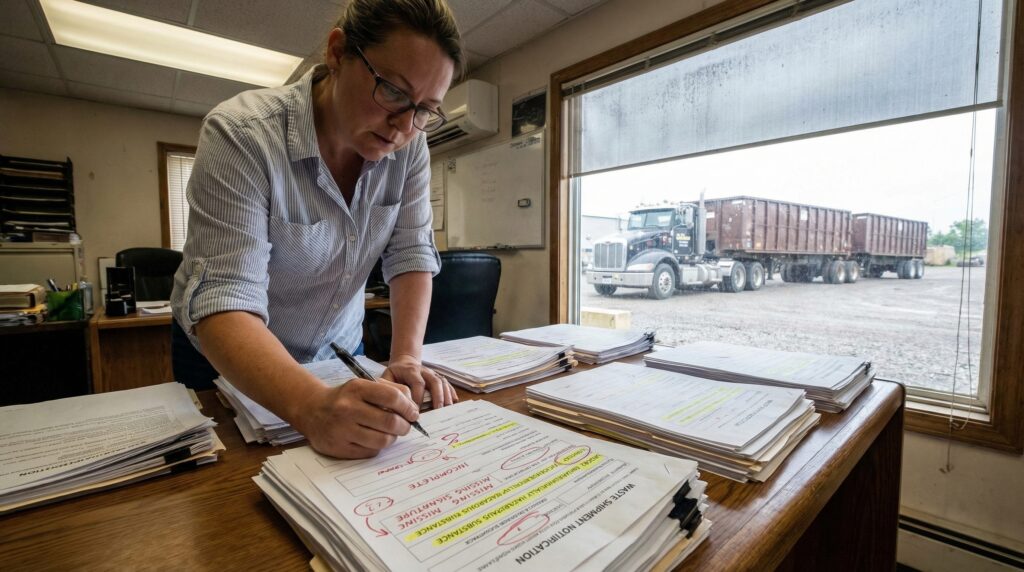
Notification of waste shipments: errors that lead to calls for additions
In practice, most delays in the notification procedure are not due to decisions of the authorities, but to deficiencies in the documentation or inconsistent information in the notification. In such situations, the authority calls for additions and the administrative procedure is stopped until these are provided.
The most common problems can be divided into several groups.
1. deficiencies in the application dossier
The first group of errors relates to the completeness of the documents. Sometimes a notification is submitted without all required attachments or without clear documentation to support the classification of the waste. Missing information on the receiving facility or incomplete data on the recovery or disposal process are also common problems.
2. inaccurate classification of waste
The authorities look particularly closely at the waste code, its origin and its properties. If the description of the waste is too general or does not clearly confirm its classification, the authority may request additional information or laboratory results.
3. inconsistent transport data
Another large group of problems are operational errors. These mainly relate to discrepancies in the data of the participants in the process - transporters, consignee or installation. There are also discrepancies regarding the planned transport route, the number of transports or the total amount of waste covered by the notification.
Financial guarantee prepared too late
Lack of financial security at the appropriate stage of the procedure is also a frequent cause of delays. If the financial guarantee is not prepared in parallel with the application dossier, this can significantly prolong the approval process.
In practice, a well-prepared dossier from the very beginning of the procedure avoids repeated requests for additions and significantly reduces the waiting time for a decision.
What changes from 21 May 2026 and why it matters for notification
While the new Regulation 2024/1157 entered into force in May 2024, most of the provisions will start to apply from 21 May 2026. Until then, the rules from Regulation 1013/2006 continue to apply for the most part. Therefore, the procedures that work today are still relevant in 2026.
The most important operational change is digitisation and mandatory DIWASS system. It will include both notification and information modes under Annex VII, and the process will become more registry-based and list-based. As a result, the importance of quality of company data, register numbers and consistency of information throughout the chain will increase.
Author: Jakub Koszyński | Editorial: Pawel Makowski