
PPWR Declaration of Conformity – who is required to draw it up, what should it contain, and when will it become mandatory?

Until recently, few companies knew what a PPWR declaration of conformity was. However, from 12 August 2026, it will become one of the key documents for many packaging manufacturers to demonstrate compliance with the new European Union regulations. By signing the PPWR declaration of conformity, a manufacturer declares that its packaging meets the requirements set out in Regulation (EU) 2025/40. Such a declaration must be supported by appropriate technical documentation and may be verified by the relevant market surveillance authorities. Many questions are already arising regarding this obligation. Who is responsible for preparing the declaration? Does it apply to all packaging? What information must it contain? And is it sufficient to prepare a single document for all products? In this article, we answer the most important questions and show how to prepare your company for the new obligations arising from the PPWR.
Are you preparing your company for PPWR?
The regulations on packaging will be further developed through subsequent implementing acts, guidelines and interpretations. We monitor changes on an ongoing basis and analyse their impact on businesses. If you would like to know what obligations will apply to your business and how to prepare for them in good time, please contact our team.:
e.nadolna@ekologistyka24.pl , +48 881 045 376
j.blazewicz@ekologistyka24.pl , +48 500 867 153
What is a PPWR declaration of conformity?
The PPWR Declaration of Conformity is a document in which the manufacturer confirms, that the packaging in question meets the requirements set out in Regulation (EU) 2025/40 on packaging and packaging waste (PPWR). It constitutes a formal declaration by the manufacturer and is one of the key elements of the system for confirming that packaging complies with the new regulations.
Importantly, the declaration itself does not ensure compliance with the law. It merely confirms that the manufacturer has technical documentation and evidence demonstrating compliance with all applicable requirements. In other words, the signature on the declaration should be the result of prior analysis, testing and the gathering of relevant information, rather than a substitute for them.
In practice
A PPWR declaration of conformity can be compared to a signed statement: „I have checked my packaging and can confirm that it meets the requirements of the PPWR Regulation.” If the supervisory authority requests evidence, the manufacturer should be able to provide it.
When will the PPWR declaration of conformity become mandatory?
The PPWR Regulation has come into force 11 February 2025., although most of its provisions will not come into force until 12 August 2026. It is from that day onwards that manufacturers will be required to draw up a declaration of conformity for packaging covered by the requirements of the Regulation.
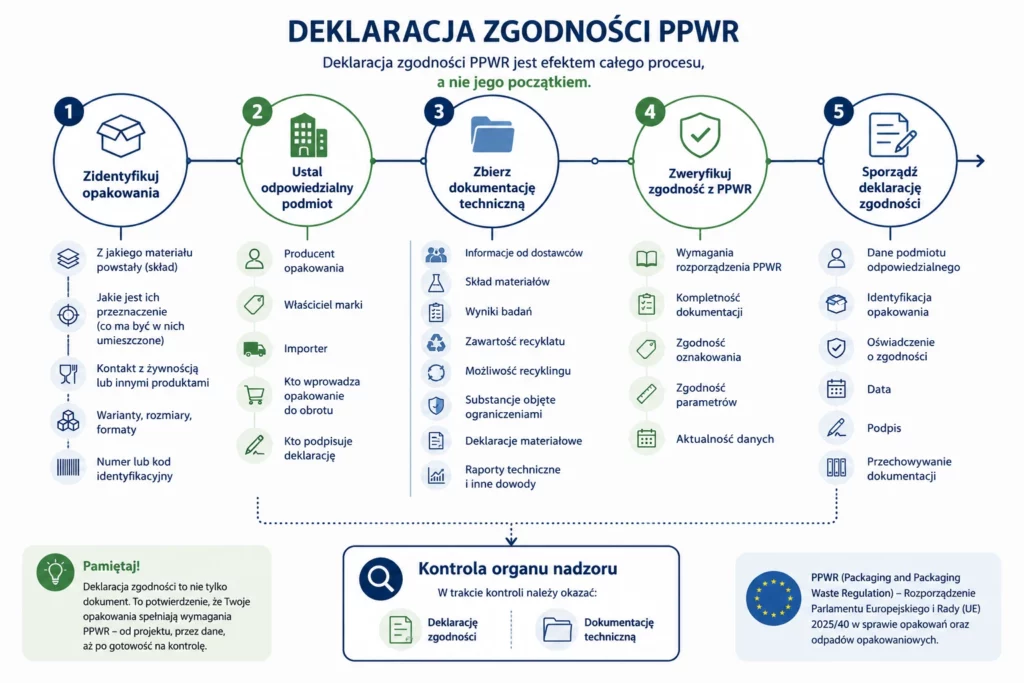
It is worth bearing in mind, however, that drafting the document itself is the final stage of the whole process. First, you need to check whether packaging meet the requirements of the PPWR, compile the relevant technical documentation and obtain information from suppliers of materials and components. Only then can the manufacturer sign the declaration of conformity with full confidence that it accurately reflects the facts.
It’s not worth waiting until the last minute
Companies that use a variety of packaging types or work with several suppliers may need months to gather all the necessary data. The sooner they start preparing, the easier it will be to avoid problems once the new regulations come into force.
Who is required to draw up a PPWR declaration of conformity?
This is one of the most frequently asked questions and, at the same time, an area where it is easy to misinterpret the regulations.
Intuition suggests that the responsibility for preparing the declaration lies with the packaging manufacturer. In many cases, this will be true, but not always. The PPWR uses its own definition of a manufacturer, and in practice the party responsible for compliance may be a completely different entity from the one that physically manufactured the packaging.
What is of key importance is that, anyone who places packaging on the market under their own name or trade mark. It is this entity that assumes responsibility for ensuring the packaging complies with the requirements of the PPWR and for drawing up the declaration of conformity. In practice, this means that the brand owner often cannot simply rely on receiving a few assurances from the supplier. They must be able to demonstrate that the packaging does indeed meet the requirements of the Regulation.
The most common pitfall
A factory may manufacture packaging, but it is the brand owner who may be responsible for ensuring its compliance with the PPWR. It is therefore advisable to establish precisely, before signing the declaration, who is considered the manufacturer under the Regulation and who bears responsibility.
Who actually signs the PPWR declaration of conformity?
Let’s imagine a simple situation.
A Polish factory manufactures plastic bottles. It then sends them to a company in Germany, which fills them with juice, puts its own logo on the label and sells the finished product under its own brand throughout the European Union.
At first glance, it might seem that the bottle manufacturer is responsible for ensuring the packaging complies with regulations. After all, it was the manufacturer who designed and produced the bottles.
Meanwhile, the provisions of the PPWR may lead to a completely different conclusion.
If the packaging is placed on the market under the name or trade mark of a German company, it is that company which may be regarded as the manufacturer within the meaning of the Regulation. Consequently, it may be that company which is responsible for ensuring that the packaging complies with the requirements of the PPWR and for drawing up a declaration of conformity.
It is therefore not worth assuming that responsibility always lies with the manufacturer. In many business models, the brand owner or importer who brings the product to market plays a key role.
Remember
In PPWR, the word „manufacturer” does not always refer to the company that physically manufactured the packaging. Liability is determined by the definitions set out in the regulation and the manner in which the packaging is placed on the market.
What must a PPWR declaration of conformity contain?
The declaration itself is not a lengthy document. However, this does not mean that it can be drawn up in any way. The Regulation specifies the information that must be included in it so that the manufacturer can unequivocally confirm that the packaging complies with the requirements of the PPWR.
In practice, the declaration should enable the three fundamental questions to be answered:
- Who Is he making a statement?
- What type of packaging? To whom does the declaration apply?
- On what basis Does the manufacturer confirm compliance with the PPWR?
Depending on the type of packaging, the declaration will include, amongst other things:
Importantly, signing the declaration does not end the manufacturer’s obligations. In the event of an inspection, the declaration alone will not be sufficient. The supervisory authority may request technical documentation to substantiate any information contained in the declaration.
This is just the beginning
The PPWR declaration of conformity is likely to be one or several pages long. The supporting documentation may run to tens, and in some cases even hundreds, of pages.
Is a single PPWR declaration of conformity sufficient?
It depends on the nature of the business and the number of packaging items used by the company. In practice, the answer is very often: no.
If a business places several different types of packaging on the market, which differ in terms of material, design or intended use, drawing up a single, general declaration may not be sufficient. Each type of packaging should be assessed against the requirements of the PPWR, and the declaration must clearly state which product it relates to.
Let’s imagine a food manufacturer who sells their products in plastic trays, glass jars and cardboard boxes. Each of these types of packaging may be subject to different technical requirements and may require separate documentation confirming compliance. As a result, the number of declarations of conformity may be significantly higher than the business initially anticipated.
That is why it is worth drawing up a list today of all the packaging used by the company. Such a simple audit will enable you to assess the scale of future obligations more quickly and avoid a situation where some packaging is overlooked.
Good practice
Don’t start by drawing up declarations. First, compile a list of all the packaging used by the company. Only then will it be easier to determine how many declarations actually need to be drawn up.
A declaration of conformity is only part of the obligations
This is where many companies may be in for a surprise. The PPWR declaration of conformity itself is a relatively short document. The biggest challenge, however, will not be writing it, but proving that the statements it contains are true.
The manufacturer should have technical documentation confirming that the packaging complies with the requirements of the Regulation. Depending on the type of packaging, this may include test results, information on material composition, data on recyclability, the content of recycled materials, the presence of restricted substances, or documents received from suppliers.
In practice, this means that preparing the declaration often requires collaboration between several departments within the company. The procurement department must obtain information from suppliers, the quality department should verify the conformity of materials, and those responsible for regulatory compliance must assess whether the documentation gathered is complete.
The more complex packaging and the supply chain become, the more important it will be to organise information effectively. In many companies, simply collecting data from suppliers will prove to be the most time-consuming part of the whole process.
Worth bearing in mind
A declaration of conformity can be drawn up within a day. Gathering all the documents to support its content may take several weeks, or even several months in large organisations.
Who is responsible for the content of the PPWR declaration of conformity?
Signing a declaration of conformity is not merely a formality. By making this declaration, the manufacturer confirms that the packaging meets the requirements set out in the PPWR and that it holds documentation to that effect.
This means that the manufacturer’s responsibility does not end with the preparation of the document. If a market surveillance authority requests clarification or documents, the manufacturer should be able to demonstrate the basis on which it confirmed that the packaging complies with the regulations.
Therefore, a declaration of conformity should not be signed solely on the basis of suppliers’ assurances or assumptions. Every statement contained therein should be supported by the technical documentation. It is this documentation that will serve as the basis in the event of an inspection.
In practice, this means that the preparation of a PPWR declaration of conformity should be viewed as part of a broader process of packaging compliance management, rather than as a single document required by law.
The biggest mistake?
Treating the declaration of conformity as merely a form to be filled in. In reality, it is a summary of the entire process of assessing the conformity of the packaging.
Is your company ready for the PPWR declaration of conformity?
For many businesses, the biggest challenge will not be drawing up the PPWR declaration of compliance itself. It may take considerably longer to organise information on packaging, verify documentation from suppliers and check whether all the requirements of the regulation have actually been met.
It is therefore not worth leaving preparations until the final weeks before the new regulations come into force. The sooner a company analyses its packaging and gathers the necessary data, the easier it will be to prepare declarations of compliance and avoid unnecessary problems during inspections.
If you are unsure whether the obligation to draw up a PPWR declaration of conformity applies to your company, it is worth carrying out a preliminary analysis before the new regulations come into force. This will enable you to identify any shortcomings and plan your actions well in advance.
5 questions you should ask yourself today
Before you draw up your first PPWR declaration of conformity, answer a few simple questions.
If the answer to any of these questions is „no” or „I don't know”, this is a good time to start preparing. In practice, it is the process of gathering documentation and organising information that takes the most time.