
Liability for errors in DIWASS – the carrier, the freight forwarder or the consignor?
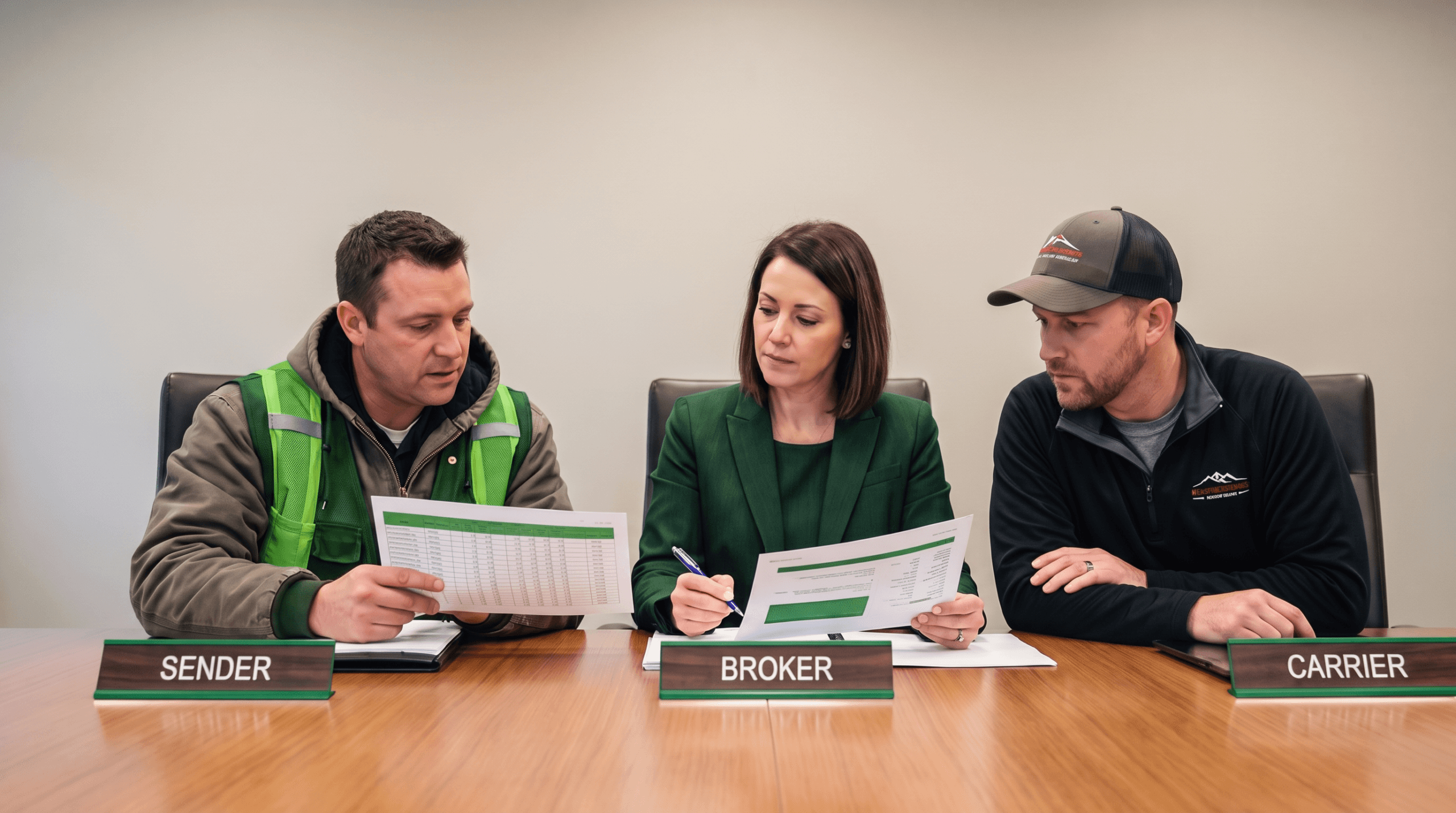
In the cross-border shipment of waste, disputes over liability have so far been resolved on the basis of paper documents, where it has often been difficult to establish the source of an error as a matter of evidence. Digitalisation is fundamentally changing this: every operation in the system has an author, a timestamp and a full audit trail, and the supervisory authorities can monitor the progress of the shipment in real time. Liability under DIWASS therefore requires a precise allocation of roles even before the shipment begins. Below, we analyse how this liability is distributed between the consignor, the broker and the carrier.
Do you need help registering on the DIWASS platform?
Contact us and entrust the care of your business to professionals:
e.nadolna@ekologistyka24.pl , +48 881 045 376
j.blazewicz@ekologistyka24.pl , +48 500 867 153
Why does the issue of liability at DIWASS raise so many questions?
Under the paper-based system, many inaccuracies „got lost” in the flow of documents. Things are different now. DIWASS creates a complete electronic audit trail, and every notification, confirmation and decision is retained in the system. What is more, monitoring is no longer carried out retrospectively – transport is supervised in real time.
In practice, this means that A mistake by a single participant can jeopardise the entire journey. If, for example, a single entity is not correctly recorded in the system, the authority may question the legality of the entire operation. It is also worth bearing in mind that the illegal movement of waste is often purely a technical matter – even when the physical transport has been carried out correctly.
Division of responsibilities – who is responsible for what?
Regulation (EU) 2024/1157 assigns responsibilities according to the participants„ roles, rather than according to who actually ”clicks’ within the system. In other words, entrusting the handling of DIWASS to a broker does not relieve the organiser of the movement of their responsibility.
| Role | Main responsibilities at DIWASS | Typical liability |
|---|---|---|
| Consignor / organiser of the movement | Registration, notification (or Annex VII), ensuring the accuracy of data on waste and the recipient, and entering into a contract with the recipient | For the legality of the entire shipment, the correct classification of the waste, and the completeness of the notification |
| Broker / trader | Registering with the system, correctly assigning one’s own role, and providing accurate data to the parties | Incorrect assignment of a role; facilitating a transfer without the required documents |
| Carrier | Account registration, route compliance with the declaration, availability of documents during inspections, confirmations in the system | For transport without a valid declaration, or where the transport does not comply with the details in DIWASS |
| Recipient / installation | Confirmation of receipt and processing of waste within the system | Failure to provide or delay in providing confirmations; acceptance of waste that does not comply with the declaration |

The supervisory authorities (GIOŚ, WIOŚ, ITD, KAS) may summon every It is up to the person involved in the movement to prove that the transport is lawful. The burden of proof therefore shifts to the operators.
The most common errors in DIWASS – real-life examples
Experts point to several recurring scenarios that lead to sanctions or the detention of shipments:

What penalties are there for making mistakes?
The financial consequences are very real. Even now, a carrier transporting waste without the required documentation risks a fine of 10,000 zł. Furthermore, the draft of the new Polish Act raises the lower limit for fines for illegal shipments: to 50,000 zł for waste subject to notification and at least 30,000 zł for green-list waste. The upper limit remains at 1 million zł. Furthermore, the Chief Inspectorate for Environmental Protection (GIOŚ) will gain the right of recourse – it will be able to claim the costs of managing illegal waste from the responsible party.
How can you minimise the risk? A quick checklist
Shared responsibility, but not blurred
Please note that liability under DIWASS does not alter the fundamental principles of EU regulations: each participant is liable within the scope of their respective roles. The consignor is responsible for the legality of the shipment and the classification of the waste; the broker is responsible for the integrity of their intermediary services and the correct identification of their own role; and the carrier is responsible for ensuring that the transport operation complies with the notification. What is new, however, is the full transparency of this division of responsibilities – a breach by one party becomes immediately apparent and may result in the entire operation being called into question. The precise allocation of roles in contracts and procedures for verifying data prior to notification are no longer merely good practice; they have become a prerequisite for the legal certainty of all parties.
Author: Jakub Koszyński | Editorial: Pawel Makowski