

Environmental stickers for waste transport

In the following article, you will find out what formal requirements trucks operating in European low emission zones must meet. We look at environmental certification schemes and their impact on the operability of transport companies, with a particular focus on the waste management sector. Reading will enable you to understand the mechanisms of emission classification and the principles of correct fleet labelling in international traffic.
Need help with certification?
Contact us and entrust the care of your business to professionals:
e.nadolna@ekologistyka24.pl , +48 881 045 376
j.blazewicz@ekologistyka24.pl , +48 500 867 153
What are environmental stickers and why are they crucial?
Environmental stickers are used to visually identify the emission class of a motor vehicle. This system allows inspection authorities to quickly verify whether a truck is allowed to operate in a protected area.
The classification system is based on three key pillars:
- Euro emission standard: attributed to a specific engine.
- Date of first registration: often crucial in the absence of full technical documentation.
- Individual identification: each sticker has a unique serial number assigned to the vehicle registration number (VIN).
The introduction of these designations aims to reduce the concentration of particulate matter and nitrogen oxides in cities. In waste transport, where routes often pass through densely populated districts, these regulations are enforced with particular stringency. For this reason, hauliers must consider these signs as a mandatory part of their fleet equipment. Correct labelling facilitates the smooth running of services and builds the image of an environmentally responsible company.
Low emission zone (LEZ) schemes in Europe
Low emission zones, known as Low Emission Zones (LEZ), are now in place in more than three hundred cities across Europe. Each Member State has its own regulations regarding the way in which heavy goods vehicles are labelled. As a result, a haulier planning an international route must check the specific requirements of each transit country.
The lack of harmonisation of regulations on a pan-European level forces companies to have several different stickers on the windscreen. However, the legislative trend is towards increasing restrictions for vehicles older than ten years. Therefore, modern waste transport fleets need to be prepared for dynamic changes in zone boundaries. Monitoring up-to-date LEZ maps is therefore an integral part of the work of the logistics department in transport companies.
Specifics of waste transport in the context of environmental standards
Waste transport is characterised by the need to drive directly to collection points located in city centres or industrial zones. Often, these sites are located inside areas where high-emission vehicles are banned. Therefore, municipal companies must have vehicles with the lowest carbon footprint. Having an environmental sticker confirms that the truck meets the requirements of the zone.
In addition, the transport of hazardous materials or waste requiring specialised equipment subject to additional roadside checks. The uniformed services first check the entitlement to enter the restricted zone. If irregularities are found, the entire logistics process is halted until the matter is clarified. Thus, taking care of up-to-date environmental labels is just as important as having transport permits for specific waste codes.
German Umweltplakette as standard for waste transport
Germany pioneered the implementation of emission control systems in cities through the Umweltplakette system. Today, almost all German cities require a green sticker that corresponds to the Euro 4 standard or higher. As a result, Polish hauliers serving the German waste market are obliged to equip their vehicles with this label. The green sticker is perpetual and assigned to a specific vehicle for the entire life of the vehicle.
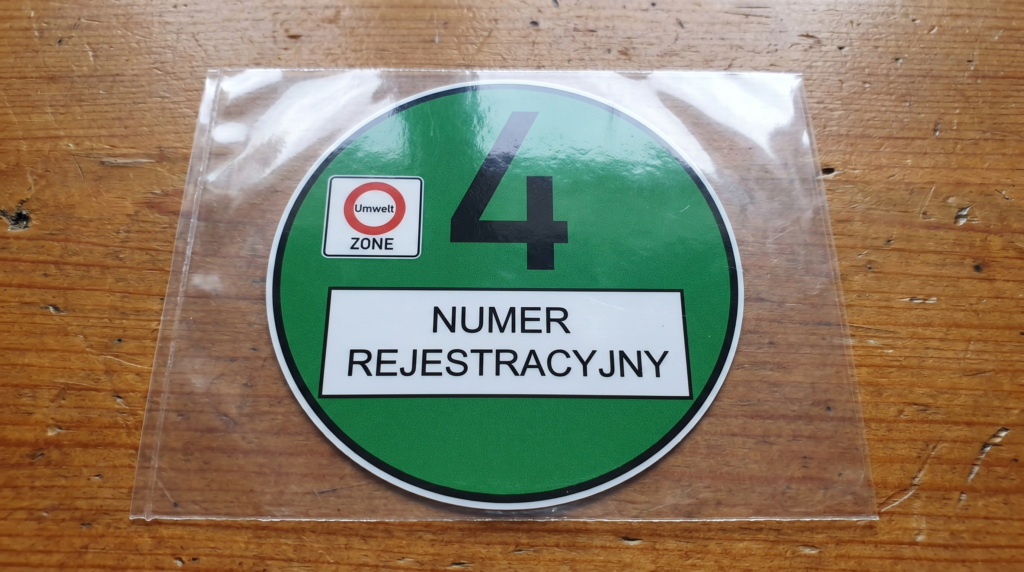
However, it is important to note that some cities, such as Berlin and Munich, impose additional bans on older diesel engines, even if they have a green sticker. For this reason, drivers transporting waste must keep an eye on the information boards at the entrance roads. In addition, the German system is very strict about the legibility of the sticker. A faded or illegible sign is treated on a par with its complete absence, resulting in an immediate fine.
The French Crit'Air system and its requirements for trucks
France has introduced an air quality certificate called Crit'Air, which is compulsory in many agglomerations such as Paris, Lyon or Grenoble. This system divides vehicles into six colour categories according to their level of emissions. For heavy transport, categories 0, 1 and 2 are the most favourable. It is worth noting that in France, zones can be permanent or activated only on days with high air pollution.
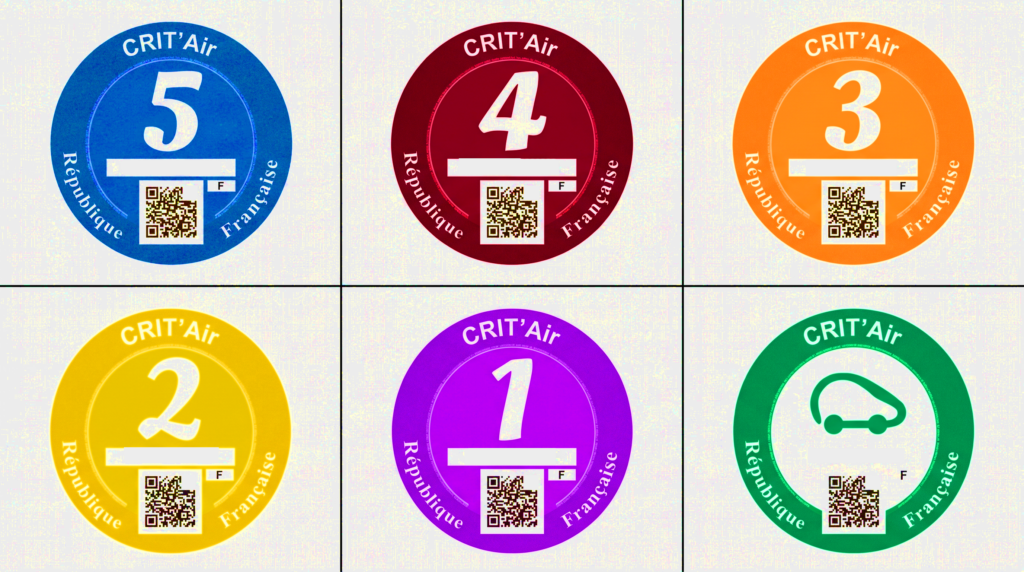
Waste hauliers fulfilling orders in the French market must register their vehicles with the official government system. This process requires a scan of the registration certificate to verify the technical data. Once payment has been made, the sticker is sent by post to the company's registered address. Failure to have this marking in the active air protection zone makes it impossible to provide municipal services and exposes the company to severe penalties.
Austrian Abgasplakette regulations for lorries
Austria has made the Abgasplakette environmental sticker mandatory for all trucks in categories N1, N2 and N3. This regulation is in force in several key federal states, including Vienna and on important transit routes in the Tyrol. For waste transports that frequently use Austrian motorways, having this sticker is absolutely required. The colour of the sticker depends directly on the Euro standard that the engine of the truck in question meets.
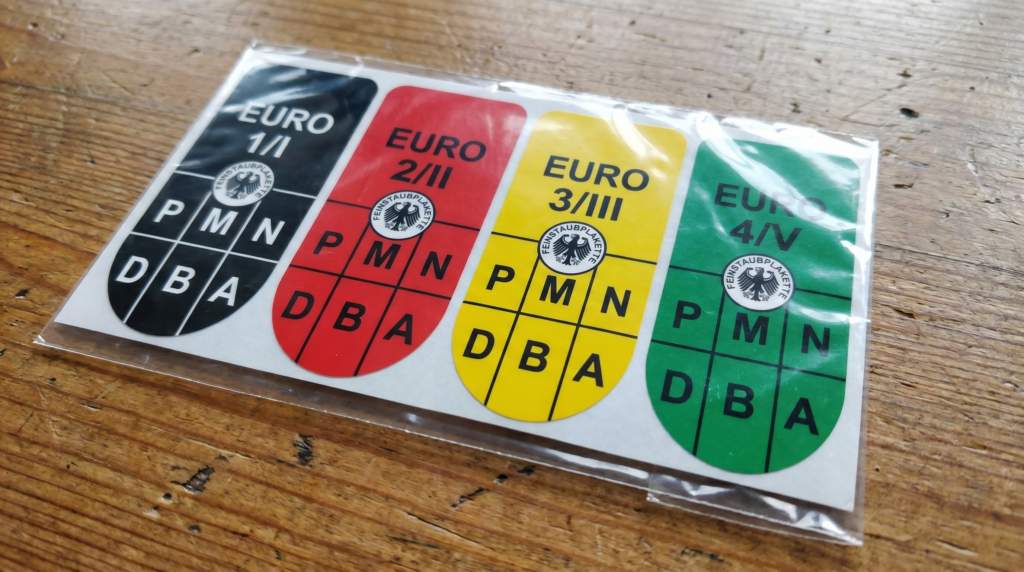
Unlike systems in other countries, the Austrian mark must be issued by an authorised diagnostic station or workshop. The documentation must clearly prove that the vehicle has not undergone illegal modifications to the exhaust system. In addition, Austria has introduced so-called sectoral bans which restrict the transport of certain goods, including waste, with vehicles of low Euro class. Thus, having an Abgasplakette is just one of the many requirements that a modern haulier must meet.
Mandatory markings for vehicles transporting waste
In waste transport, environmental stickers coexist with other mandatory markings, such as a white board with the letter „A”. In Germany, the sign indicates the transport of waste in accordance with the Closed Economy Act. The combination of these two types of labelling is essential for the legal execution of orders. The inspection services pay attention to the consistency of the data on the environmental stickers and the transport documents.
In addition, special signs are required in some regions to indicate the noise level generated by the vehicle. Waste transport often takes place at night or in the early morning, which generates additional restrictions. The fleet must therefore be equipped with a complete set of certificates and stickers visible to other road users. A comprehensive approach to vehicle marking minimises the risk of errors during roadside checks.
Legal and financial consequences of no stickers
Failure to display the required environmental sticker in a restricted emission zone results in an immediate fine. The fines vary from country to country and can range from €80 to as much as €2,185 in extreme cases. It is worth noting that the fine is most often charged to both the driver and the owner of the transport company. In addition, the vehicle may be diverted to a guarded car park until the matter is cleared up, which generates additional downtime costs.
However, financial losses are not the only problem resulting from ignoring environmental regulations. Repeated violations can lead to the loss of a haulier's good reputation, which is crucial in tendering processes for waste disposal. Municipalities and large industrial plants are increasingly demanding documented environmental care from contractors. For this reason, lack of stickers can result in the termination of lucrative contracts and exclusion from the market.
How to effectively prepare a fleet for international transport?

- Fleet audit: Verification of the Euro standards of all vehicles and attribution of the corresponding certificates.
- Digitising the base: Creation of a register of badge expiry dates and their serial numbers.
- Driver education: Training in the recognition of international LEZ markings (e.g. signs Zone à Faibles Émissions).
- Technology: Implementation of GPS systems with up-to-date maps of restricted emission zones.
It is also worth using modern GPS navigation systems, which have the function of bypassing restricted emission zones. However, if the order requires an entry into the city centre, the missing environmental stickers. The process of issuing them can take anywhere from a few days to two weeks, so planning must be ahead of the order. Proper prevention in this area guarantees the operational security of the company.
Procedure for obtaining environmental stickers for lorries
Obtaining an environmental sticker requires the presentation of the vehicle registration certificate in physical or digital form. Based on the total weight, fuel type and year of manufacture, an official will assign the vehicle to the appropriate class. In most European countries, this process can be carried out through dedicated online portals. After positive verification and payment of the administrative fee, the sticker is sent to the applicant.
Please note that the sticker must be placed in a prominent position on the windscreen, usually on the passenger side. Failure to place the sticker correctly, for example behind the sun belt, may be grounds for a fine. If the windscreen is replaced due to damage, it is necessary to obtain a new sticker. This procedure is standard, but requires vigilance on the part of the technical staff of the transport base.
The future of waste transport in low-carbon zones
Trends in the European Union's climate policy indicate a systematic tightening of requirements for heavy transport. In the coming years, many cities are planning to convert low emission zones into zero emission zones (ZEZ). This means that only electric or hydrogen-powered vehicles will enter city centres. Waste hauliers must therefore plan investments in rolling stock with these far-reaching changes in mind.
The current green stickers represent a transitional phase in the decarbonisation of urban transport. Companies that are already committed to the highest standards and the correct labelling of their fleets will find their way more easily into the new reality. Education in environmental standards and attention to legal details are becoming the foundation for success in the municipal industry. Modern waste transport requires not only the efficient transport of loads, but above all the full adaptation of the fleet to environmental regulations.
Author: Jakub Koszyński | Editorial: Pawel Makowski